Culture and Identity
The culture of Bhutan is not a relic of the past; it is a living, breathing identity that shapes every mountain pass and modern street corner. To travel here is to step into a world where ancient spiritualism and 21st-century vision coexist in perfect harmony.
Architecture
Bhutanese architecture is immediately recognizable- bold, harmonious, and deeply symbolic. From the stone-and-earth walls of rural homes to the towering fortresses that anchor valleys, buildings in Bhutan are more than functional structures; they are cultural statements shaped by history, spirituality, and environment.
Strongly influenced by Tibetan Buddhism, traditional Bhutanese architecture is notable for being constructed without nails or iron bars. Remarkably, many historic dzongs were built without written architectural plans, relying instead on sacred proportions, oral knowledge, and master builders’ intuition.
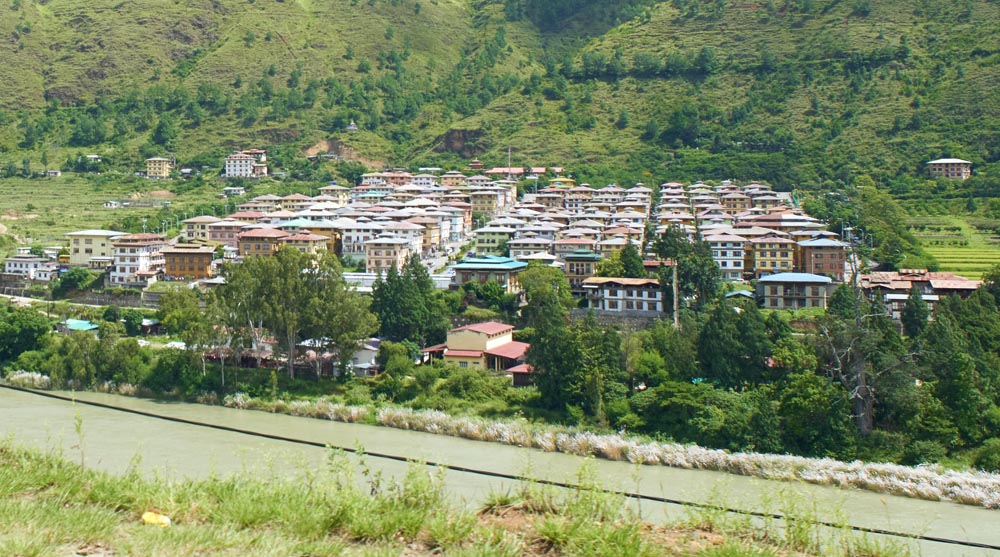
A royal decree issued in 1998 ensures that all buildings in Bhutan adhere to traditional architectural principles, even when modern materials are used. As a result, Bhutan’s towns and villages retain a cohesive visual identity. In western Bhutan, homes are typically built with rammed earth walls, timber frames, carved wooden windows, and sloping roofs.
Exterior walls are often adorned with religious motifs or phallic symbols- believed to ward off evil and promote fertility. In warmer southern regions, houses are constructed from bamboo and thatch, adapted to the subtropical climate. Traveling across the country offers a living gallery of architecture that remains rooted in tradition while continuing to evolve.
Get a taste of Bhutanese architecture as part of our “Cultural Journey (14-day) itinerary”.
The Mighty Dzongs
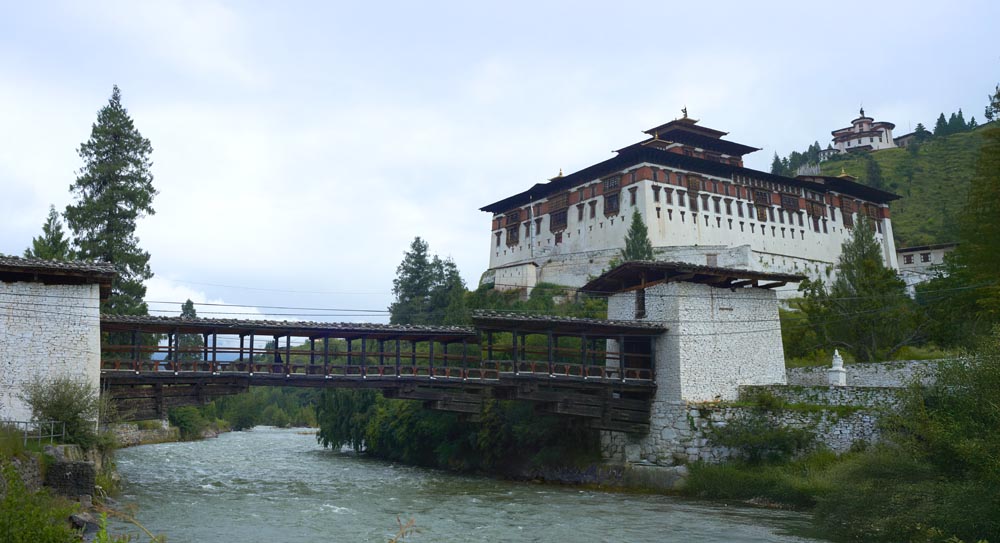
These massive fortresses were first envisioned by Zhabdrung Ngawang Namgyel in the 17th century to serve as both defensive bastions and administrative hubs. Built strategically at river confluences or valley entrances, dzongs symbolize both spiritual authority and national unity.
Characterized by thick, inward-sloping stone walls, dzongs are whitewashed for a uniform appearance and entered through a single, heavily fortified gate. At their heart stands the utse, or central tower, which houses the most sacred spaces.
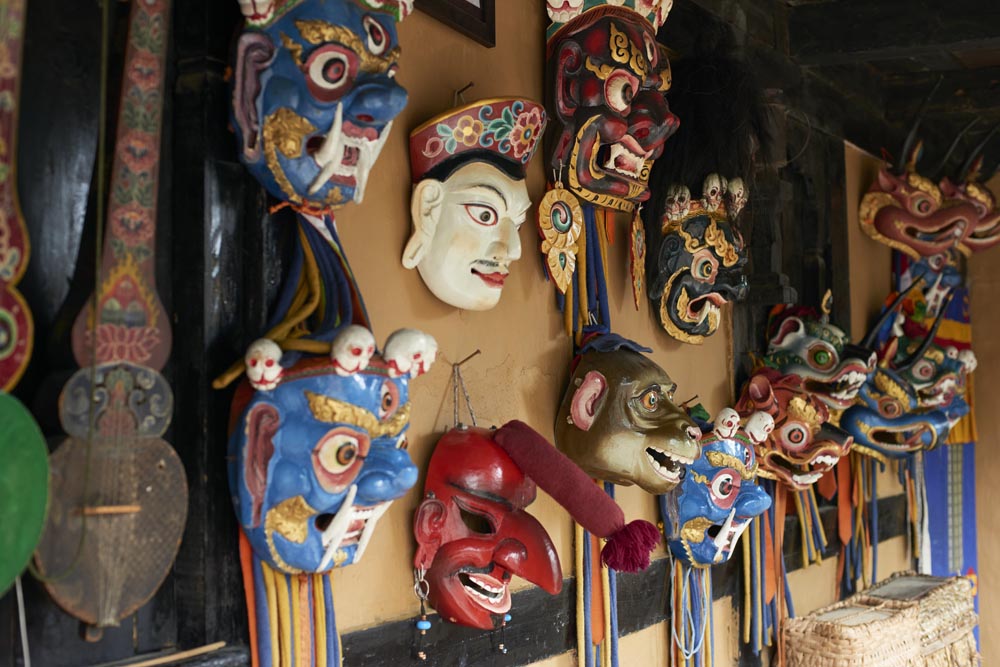
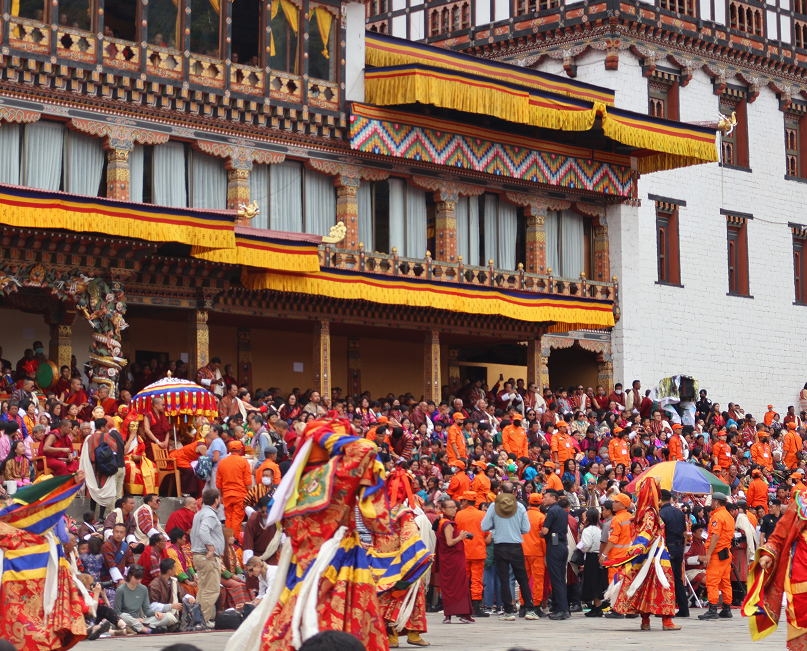
Large open courtyards within dzongs host annual religious festivals, or tsechus, where masked dances and rituals are performed. Though many dzongs have suffered fires over the centuries, careful reconstructions have preserved their original design and grandeur.
Learn more about tsechus and other iconic festivals in “Fantastic Festivals.”
Traditional Homes and Sacred Structures
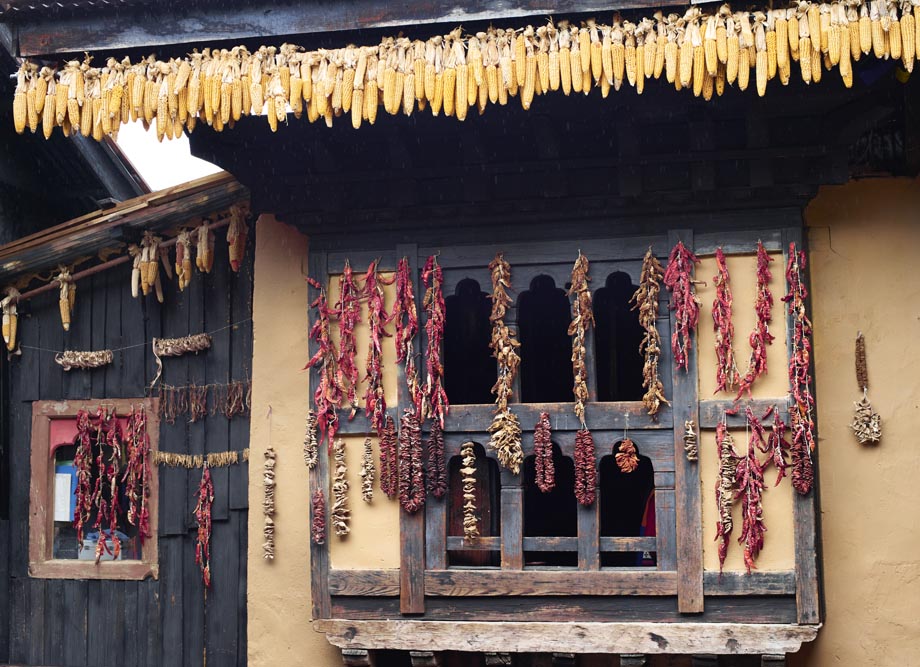
In Western Bhutan, houses are monumental structures of rammed earth and timber, often three stories high. Traditionally, the ground floor sheltered livestock, the middle floor served as the family’s living quarters, and the open-air attic was reserved for drying scarlet chilies. As you move further East, homes transition to sturdy stone slabs, while the Southern part of the country features airy dwellings made of woven bamboo to suit the sub-tropical heat.
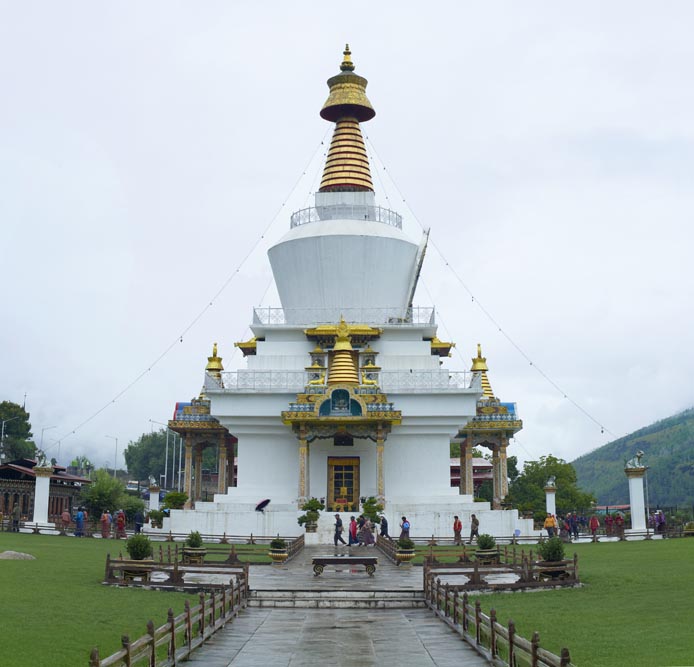
Religious architecture follows similar principles. Lhakhangs (temples), monasteries, and chortens (stupas) mirror dzong-style elements such as whitewashed walls and sloping roofs. Monasteries are richly decorated with intricate murals depicting Buddhist cosmology and saints. Chortens, with their square bases and domed tops, are built from stone and mud and painted white, serving as focal points for daily circumambulation and prayer.
Bridges of Connection
Connecting these traditional homes and sacred sites are Bhutan’s famous cantilevered bridges. These are anchored at both ends without vertical supports and span fast-flowing rivers and deep gorges, connecting communities that would otherwise remain isolated. These bridges are vital routes for pilgrims, villagers, livestock, and travelers alike. Often draped in fluttering prayer flags, they are both functional infrastructure and spiritual passageways, blending engineering with devotion.
Art and Music
Bhutan’s history, spirituality, and national identity are vividly expressed through its art and music. These traditions, passed down and reshaped over generations, form a rich cultural tapestry that continues to thrive. Bhutanese art is heavily influenced by Tibetan Buddhist iconography, depicting deities such as Guru Rinpoche, Padmasambhava, and Pema Lingpa. Murals, thangka paintings, sculptures, and carvings adorn dzongs, monasteries, and homes across the country.
The country’s artistic heritage is formally categorized into the 13 traditional arts and crafts known as Zorig Chosum, which include painting, wood carving, sculpture, embroidery, and metalwork. For visitors interested in these traditions, institutions such as the Zorig Chosum Institute and contemporary art galleries offer valuable insight into both classical and modern Bhutanese art.
Music in Bhutan ranges from ancient folk traditions to modern pop. Folk songs tell stories of love, nature, and spirituality and vary widely by region. These are often performed at tsechus alongside traditional dances. Religious music, including chants and ritual instruments, is performed by monks during ceremonies and mask dances. Traditional instruments include the dranyen (seven-stringed lute), chiwang (fiddle), dong lim (bamboo flute), and chikang (mouth organ).
The Royal Academy of Performing Arts (RAPA) plays a key role in preserving and promoting Bhutanese music and dance, training performers in both secular and religious traditions. At the same time, contemporary Bhutanese pop music, or B-pop, has surged in popularity. Influenced by Western pop, K-pop, and hip-hop, it dominates radio stations, cafés, and social media, showcasing the creative energy of Bhutan’s younger generation.
There is only so much that you can read about Bhutan’s rich culture of art and music. It must be experienced by visiting galleries, museums, monuments and attending live performances. Find out more by looking into our “7 or 14 day itineraries” or contact us for more information.
Bhutanese Textiles
To truly understand the aesthetic of Bhutan, one must look at its clothes. In a world of fast fashion, Bhutan remains a place where the most prized possessions are often hand-woven masterpieces that take months, or even years, to create. For the traveler, Bhutanese textiles are not just souvenirs; they are wearable art and a profound connection to the kingdom’s living heritage.
Bhutanese textiles are celebrated globally for their rich colors, sophisticated patterns, and intricate dyeing methods. The variety and splendor of these local fabrics are most apparent during festivals, when the community gathers in a breathtaking display of their finest hand-woven garments.
The National Dress: Gho & Kira
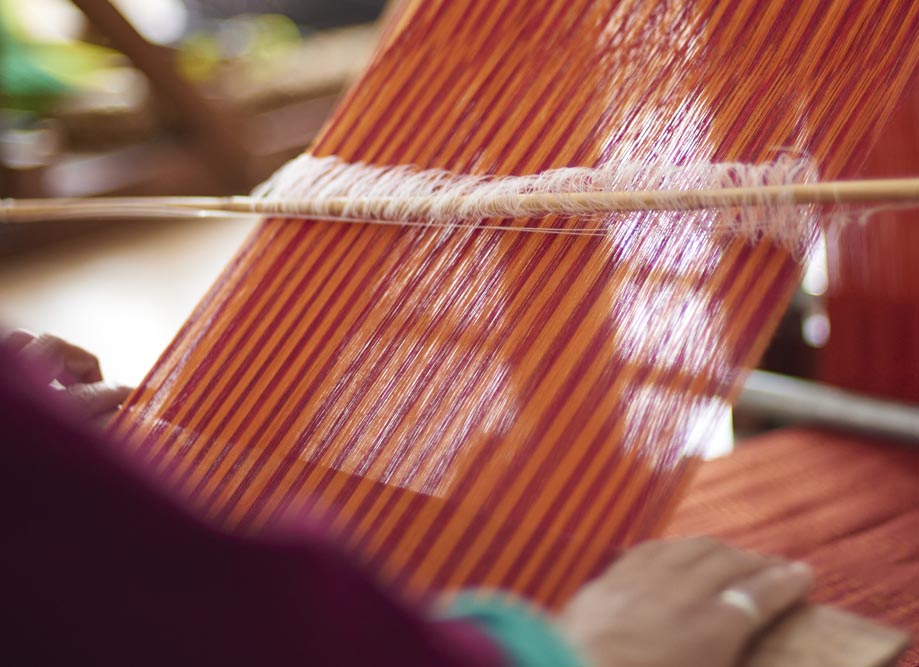
Since the 17th century, the national dress has been a cornerstone of Bhutanese identity.
For men, the Gho is a knee-length robe tied at the waist by a belt called a kera. It is famously known for creating the world’s largest pocket (the folded pouch above the belt) traditionally used to carry everything from wooden bowls to mobile phones.
For women, the Kira is an elegant, floor-length wrap dress secured at the shoulders with silver brooches called koma and topped with a silk jacket known as a tego.
When visiting a Dzong or a government office, men add a silk scarf called a kabney, and women wear a hand-embroidered rachu over their shoulder. The colors of these scarves denote the wearer’s rank, weaving a clear social fabric into everyday life.
The Sacred Art of Thagzo
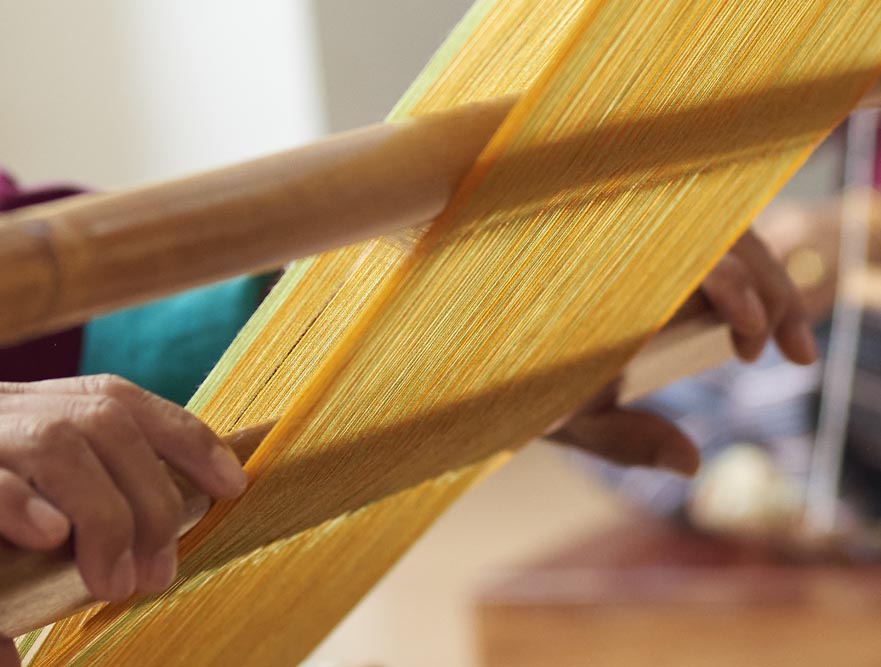
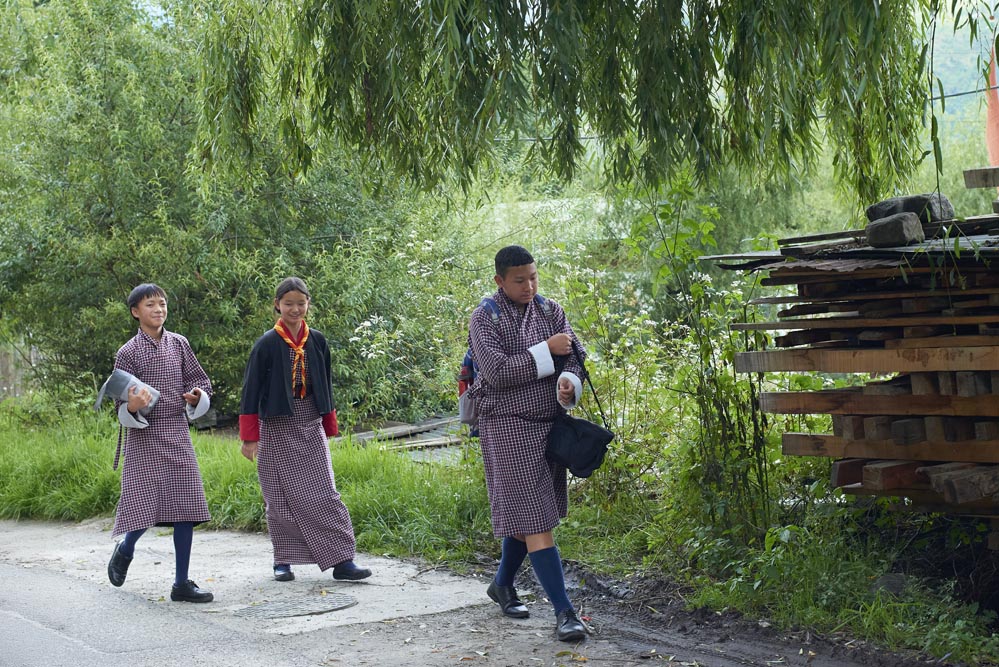
Of the thirteen celebrated arts and crafts of Bhutan, thagzo refers to the art of weaving. This is one of the oldest vocations in the kingdom, embedded in our history and daily way of life.
According to legend, weaving was first introduced to Bhutan in the 7th century by the wife of the Tibetan King Songtsen Gampo. Today, weavers continue to hone this craft, often learning the intricate techniques from their mothers and grandmothers.
Traditionally, weaving was a winter vocation, practiced when the fields lay fallow and the harvest was complete. In ancient times, these precious textiles were even used as a form of currency and payment. Today, many women in rural Bhutan continue to weave to supplement their income, keeping these ancient patterns alive.
Patterns, Motifs, and Kishuthara
Bhutanese textiles differ from region to region, featuring a variety of complex motifs and colors. While there are many prized patterns, the kishuthara stands above the rest. This is the pinnacle of the craft, a silk-on-silk Kira featuring patterns so intricate they appear embroidered, though they are actually woven entirely by hand. The districts of Eastern Bhutan are especially renowned for producing these prized weaves.
We recommend visiting the Royal Textile Academy in Thimphu to see the evolution of royal fashion and understand the technical mastery required for each design. From there, we can guide you through the local handicraft stores and clothes shops to find the design that best suits your fancy.
For those wanting to fully immerse themselves, we can arrange for you to be fitted for your own traditional dress to wear during a festival or a private farmhouse dinner. For the discerning traveler, bringing home a piece of Bhutanese textile is bringing home a piece of history. Whether you seek a raw silk scarf or a full ceremonial Kira, these items are heirlooms built to last a lifetime.